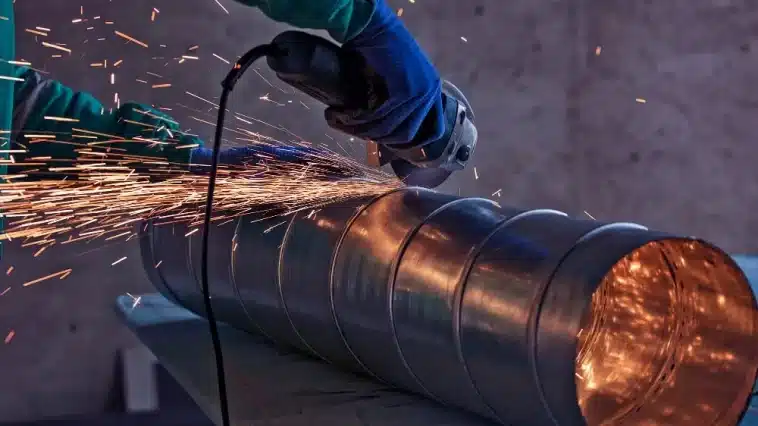
What is pipe welding? This question arises and preoccupies many people due to its importance in various industries. Let’s learn about it with some small details suitable for beginners who are passionate about this field. When we talk about it, we are discussing advanced industrial skills that have a clear use: connecting each pipe to another in a strong manner.
This type of welding is considered one of the basic materials used in various fields such as gas, petroleum, power plants, and construction. Let’s learn about the meaning of these pipes, how welders use them, and how much they earn through their work in this field. Stay with us until the end.
What is Pipe Welding?
Pipe welding is responsible for connecting metal pipe parts together in a strong and durable manner, relying on welded materials and high heat to ensure high pressure resistance and strong joints. This type is used in gas and oil systems, as well as water pipe welding.
Pipes are exposed to harsh conditions such as difficult environments and high pressure, and the main purpose of pipe welding is to create strong joints that prevent any gas or air leaks while ensuring the safety of citizens and the integrity of the system.
What are The Techniques and Types of Pipe Welding?
Now that we have discussed what is pipe welding, we will now discuss the most important types and techniques, as the methods vary depending on the thickness of the pipe, the type of material, and the surrounding environment. These include the following:
- TIG welding: Very suitable for thin metals and stainless steel, and the results are high quality.
- Stick welding: Used in various conditions and more suitable for thick materials, but requires a highly experienced welder to control quality.
- MIG welding: A fast and very effective type for aluminium and carbon metals, suitable for flat positions.
- Orbital welding: This type is used in circular or straight pipes and ensures high quality with less chance of errors.
- Closed metal wire welding: This type results in high deposition and deep penetration and is well suited for thick pipes.
Learn More: What are The Pipe Welding Clamps? The Best Guide
Why TDCO Industrial for Pipe Welding?
TDCO Industrial is a trusted partner for organisations seeking high-performance pipe welding solutions that meet strict industrial and regulatory standards. Our operations are built around engineered precision, allowing us to deliver consistent weld integrity across oil & gas, petrochemical, power generation, and heavy-industry projects.
We combine certified welding teams with advanced processes—TIG, MIG, Stick, and orbital welding—to ensure full compliance with project specifications, pressure requirements, and material complexities. TDCO Industrial also provides comprehensive support throughout the project lifecycle, including pipe preparation, joint fit-up, welding execution, non-destructive testing (NDT), and quality documentation.
For project inquiries, technical consultations, or partnership opportunities, you can reach our industrial team directly at industrial.tdco@gmail.com or +1-404-438-1180.
Read More: Pipe Welding Tips Every Welder Should Know
Conclusion:
In summary, after discussing the topic of what is pipe welding and its uses in various fields, we found that it is one of the basic elements in the construction of industrial facilities and advanced infrastructure. This field helps you understand the vital role and importance it plays in projects that rely on pipes, whether directly or indirectly.
FAQs:
What Do Pipe Welders Do?
Pipe welders are technicians who specialise in welding, installing, and preparing metal pipes for use in various industries. They must be precise because there is no room for error, as this could lead to leaks or high pressure, resulting in serious problems. Their tasks include:
Preparing pipes by cleaning, cutting, and smoothing their ends before welding to ensure precision.
Reading engineering drawings to understand the type of joints and pipe sizes required.
Installing pipes in the correct location and connecting them to all parts of the industrial system.
Welding pipes accurately to ensure the strength and tightness of the connection.
Conducting tests to check the quality of the welding to ensure that there are no gaps or cracks.
Strict adherence to safety standards, as they are dealing with high temperatures and heavy metals.
How Much Do Pipe Welders Make?
The earnings of each welder vary depending on the person’s experience and the tasks they perform, but in general, their salaries are higher than those of ordinary welders for the following reasons:
Welding is a high-risk job, and even a minor mistake can cause explosions, gas leaks, serious environmental damage, and very costly fines for the company.
Companies are looking for welders with high technical skills, who must have extensive experience in preparing joints and controlling heat, and therefore pay them large sums of money.
Welding is a job that requires great precision and skill because it is an industrial field, and the person must focus on gas lines, oil, high-pressure environments, and high temperatures.
How does a welder choose the right process for pipes?
The welder first checks the pipe material and thickness. It is best to use TIG, as it is suitable for stainless and thin pipes. The pipes are welded with a rod, which works well outdoors, or use fast MIG if the steel is soft.
What are the best ways to prevent porosity after welding?
The pipe must be thoroughly cleaned before welding, after which a specialist removes dirt, rust, and oil, taking care to use a suitable protective gas and ensuring that the process is free of leaks. Thorough cleaning is necessary, as it prevents air from adhering to the weld.